



2026 Mazda CX-50 vs. CX-70: Which Is Right for You?
Choosing between the 2026 Mazda CX-50 vs. CX-70 comes down to what’s important during your daily drives in Eugene. Catering to different driver needs and lifestyles, the CX-50 is more compact and thrives on off-road Oregon trails, while the CX-70 is a comfortable midsize SUV with ample space for enjoyable family trips. This car comparison, compiled by us at Kiefer Mazda, will help you decide which one is right for you and your family.
CX-50 vs. CX-70: Understanding Mazda’s Two-Row SUV Lineup
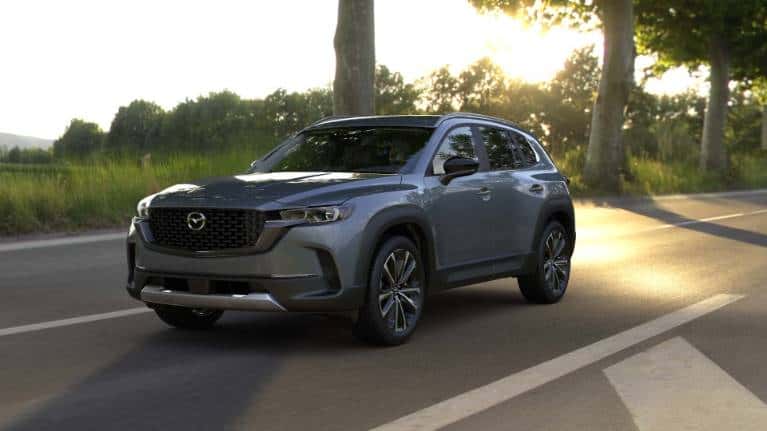
Built for the outdoor enthusiast, the Mazda CX-50 brings a rugged, adventure-ready attitude to the compact crossover segment. It’s perfect if you’re keen on forest trails yet need daily practicality. With a budget-friendly starting MSRP of $29,900, there are seven Mazda CX-50 trims to match any planned adventure.
Mazda’s upscale midsize SUV, the Mazda CX-70, takes a different approach with plush materials, smart technology, and family-first comfort features. It’s similar to the three-row CX-90 but sticks with two rows to maximize cargo room and has a starting price of $42,250. Both SUVs are available as gas-only models but also have hybrid and plug-in hybrid options, perfect for eco-conscious drivers.
Size and Dimensions: Compact vs. Midsize Comparison
The compact CX-50 is 185.8 inches long, 75.6 inches wide, and 63.9 inches tall with a 110.8-inch wheelbase. This small footprint simplifies parking in downtown Eugene. The hybrid version’s tight turning radius of 35.4 feet is perfect for U-turns on narrow streets or navigating winding Cascade Mountain roads. The Mazda CX-50’s ground clearance of up to 8.6 inches vs. the CX-70’s 8.1 inches makes it a winner on rough terrain.
The CX-70 is 200.8 inches long, 78.5 inches wide, and 68.2 inches tall on a 122.8-inch wheelbase, giving it more room where it counts. Front passengers get 41.0 inches of legroom, compared to 41.7 inches in the CX-50, while rear passengers enjoy 39.5 inches vs. 39.8 inches. You’ll notice the difference in cargo space, with the CX-70 offering 30.9 cubic feet behind row two and 60.1 cubic feet with seats down compared to the CX-50’s 31 cubic feet and 56 cubic feet, respectively.
Performance and Powertrain Options
Engine choices tell you a lot about these SUVs’ capabilities. The CX-50 has a 2.5-liter four-cylinder generating 187 horsepower and 185 lb-ft of torque or a turbo 2.5-liter producing 256 horsepower and 320 lb-ft of torque with premium gas. Both are paired with a six-speed automatic transmission. Hybrid fans can opt for a 2.5-liter engine with three electric motors producing a combined 219 horsepower that accelerates from 0 to 60 mph in 7.6 seconds.
The CX-70 showcases its power with a turbocharged 3.3-liter inline-six that produces 280 horsepower and 332 lb-ft of torque, paired with an eight-speed automatic transmission. The high-performance variant generates 340 horsepower and 369 lb-ft of torque and achieves a 0-to-60 mph sprint time of 6.2 seconds. The plug-in hybrid combines the six-cylinder with electric power for a combined 323 horsepower and 369 lb-ft of torque and accelerates from 0 to 60 mph in 6 seconds.
Towing shows the biggest difference — the CX-50 has a maximum capacity of 3,500 pounds with the turbo engine and 2,000 pounds with the base engine, while the CX-70 can pull 5,000 pounds regardless of engine. Mazda’s solid reliability track record backs both options. The brand topped the charts in Consumer Reports’ 2021 reliability rankings and beat the industry average in J.D. Power’s 2023 Dependability Study. With proper care, you can expect 155,000 to 200,000 miles from either SUV.
Fuel Economy and Efficiency Comparison
Fuel efficiency favors the smaller CX-50, though both models are reasonable for their class. The base CX-50 has an EPA-estimated 24 mpg in the city and 30 mpg on the highway, while the turbo drops to 23 mpg in the city and 29 mpg on the highway. Real-world tests back this up, with the turbo CX-50 achieving 29 mpg on the 75 mph highway run. The hybrid model is the efficiency champ at 38 mpg combined, making it ideal for your daily Eugene commutes.
Despite its size and stronger engines, the CX-70 holds its own at 23 mpg in the city and 28 mpg on the highway. During highway tests, it matched the turbo CX-50, achieving 29 mpg at a cruising speed of 75 mph. The standout is the plug-in hybrid, which offers a 26-mile all-electric range and a total driving range of 490 miles. Its 25 mpg on gas and 56 MPGe in electric mode are perfect if you want minimal fuel costs during the week but need road trip range on weekends.
Interior Features and Technology
Cabin designs reveal the different priorities with practical adventure-ready features in the CX-50 and spacious, premium touches in the CX-70. Both feature 10.3-inch infotainment displays supporting wireless Apple CarPlay and Android Auto, but the CX-70 upgrades with dual 12.3-inch screens in higher trims. An eight-speaker audio system is standard in the CX-50, with a 12-speaker Bose system in the Premium models. The CX-70 includes a 12-speaker Bose system in the Premium trims and features Alexa Built-in and the MyMazda app for remote control of your vehicle.
Both models seat five passengers, but space and comfort vary. The CX-70 gives passengers 141.6 cubic feet of total volume compared to the Mazda CX-50’s dimensions of 100.3 cubic feet. All CX-70 models have heated and ventilated front seats with an eight-way power adjustment, while the CX-50 covers the basics with heated front seats, a power driver’s seat, and a programmable power liftgate that’s perfect for loading hiking gear after a muddy trek.
Safety Features and Driver Assistance
Mazda’s i-Activsense, standard in both SUVs, features blind-spot monitors, rear cross-traffic alerts, and radar cruise control with full stop-and-go. It also includes automatic braking, lane-keeping, and driver attention alerts. The 2025 CX-50 earned a five-star overall safety rating from the National Highway Traffic Safety Administration, while both models received the Insurance Institute for Highway Safety’s Top Safety Pick+ awards.
The CX-70 wins with advanced driver assistance on higher trims. These include improved adaptive cruise control, traffic jam assist, and a 360-degree camera system that monitors driver alertness during long highway stretches. Both SUVs offer surround-view cameras on the upper trims, giving you visibility when maneuvering into tight downtown parking spots or navigating narrow Oregon forest roads.
Find Your Perfect Mazda SUV at Kiefer Mazda
If you want a compact, budget-friendly SUV with solid off-road skills, the CX-50 is your perfect match. It’s ideal for Eugene locals who need city maneuverability but enjoy Cascade trails on weekends. The CX-70 is for you if you enjoy a vehicle with luxury, space, and muscle that can take your family on a Willamette Valley road trip in comfort and have space for a few bottles of special wine. The only way you’ll know for sure is by test-driving both, so contact us today and book your test-drive at Kiefer Mazda in Eugene.
Image courtesy of Mazda USA
0 comment(s) so far on 2026 Mazda CX-50 vs. CX-70: Which Is Right for You?