



2026 Mazda CX-5 vs. Honda CR-V
Two names keep coming up when Oregon shoppers start comparing compact SUVs: the Mazda CX-5 and the Honda CR-V. Both have earned their popularity, and for good reason. Each one delivers real comfort, solid tech, and the kind of everyday usability that makes a compact SUV worth owning. But they take noticeably different approaches to the formula, and for drivers in Eugene dealing with rain-slicked streets, mountain passes, and unpredictable backroads, those differences matter.
Our take: the 2026 Mazda CX-5 is the stronger choice for most Oregon drivers, particularly those who want standard AWD, a refined cabin, and a more connected drive at every trim level. If that sounds like you, view our current CX-5 inventory to see what’s available now.
Pricing and Value: How the CX-5 and CR-V Stack Up
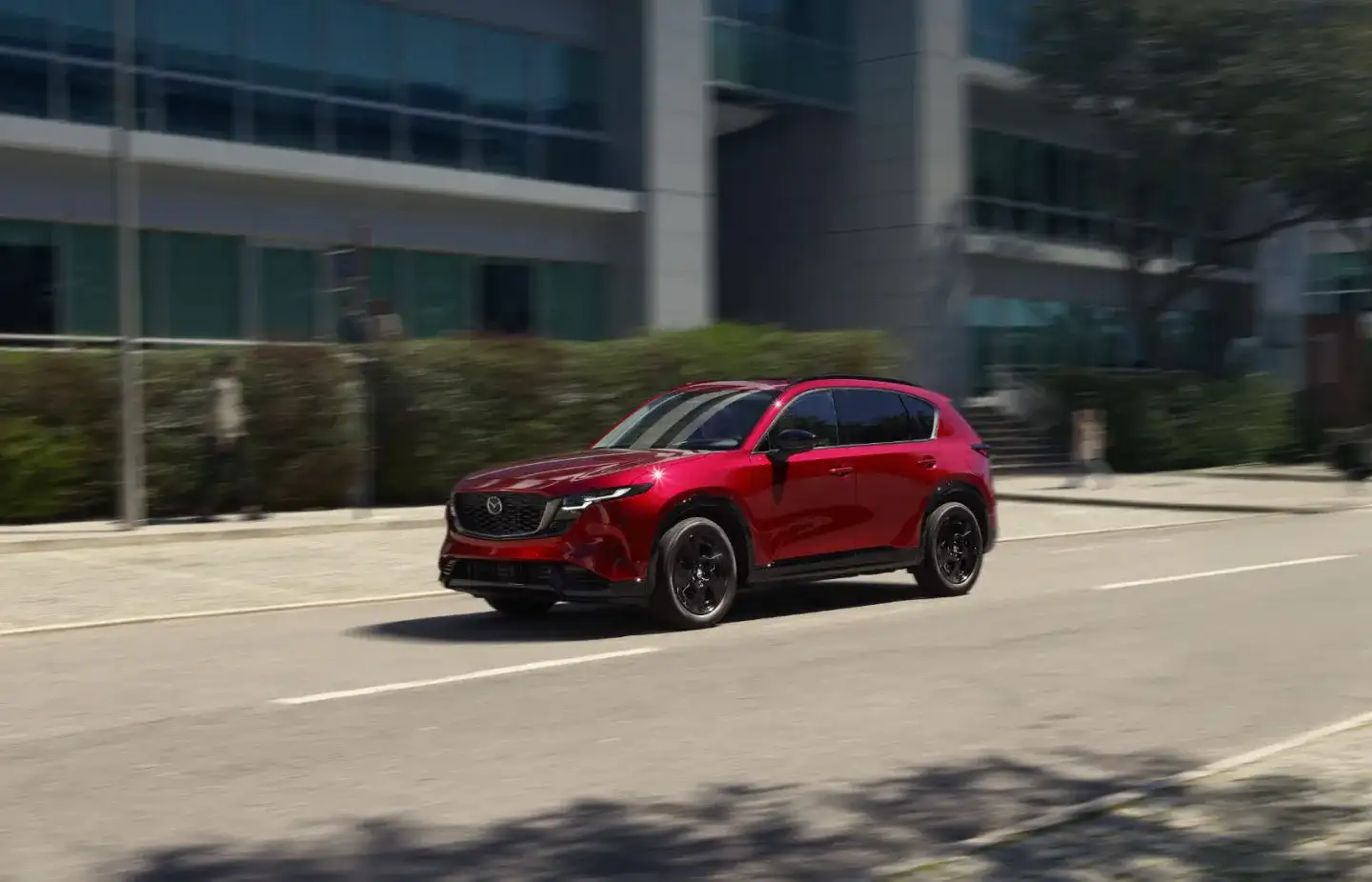
The more interesting comparison between these two SUVs isn’t the sticker price; it’s what you actually get at each price point. The CX-5 delivers a more premium feel at entry-level trims, with materials and design details that feel closer to a luxury vehicle than a standard compact SUV. The CR-V builds its value argument around space and family-focused features.
The CX-5 AWD Advantage
One of the most important value differences doesn’t show up in a features list: AWD is standard on every 2026 Mazda CX-5 trim. On the CR-V, AWD is available but not standard on base trims, meaning buyers who want it must pay more or select a specific trim. For Oregon drivers who want all-weather capability without having to think about it, that distinction carries real weight.
Touchscreen and Standard Technology
The CX-5 also starts with a 12.9-inch touchscreen across all trims. The CR-V’s standard display measures 9 inches. That’s a 4-inch gap that shows up every single day, and it’s there from the base trim without any upgrade required. The CX-5’s standard AWD and larger display together represent genuine value you don’t have to pay extra to access.
Performance and Powertrain Comparison
Performance is one of the clearest dividing lines between these two vehicles. Mazda built the CX-5 with driver engagement in mind; Honda tuned the CR-V for smoothness and practicality. They produce very different experiences behind the wheel, especially on the winding, variable-terrain roads common throughout Oregon.
The 2026 CX-5 uses a SkyActiv-G 2.5L inline four-cylinder producing 187 hp and 186 lb-ft of torque, paired with a 6-speed automatic transmission. Steering is well-weighted and communicative, giving drivers a sense of road connection that stands out in this class. The CR-V uses a 1.5L turbocharged four-cylinder rated at 190 hp and 179 lb-ft of torque through a CVT. It’s smooth and predictable for commuting and highway cruising.
The CR-V hybrid raises the output to 204 hp and a substantial 247 lb-ft of torque through an e-CVT, which is a real advantage for buyers prioritizing efficiency and low-end pull. AWD is still not standard on all CR-V trims, though it is standard on the TrailSport Hybrid and Sport Touring Hybrid.
What sets the CX-5 apart in Oregon conditions is i-Activ AWD. The system continuously monitors wheel slip, steering input, brake activity, and road conditions to distribute torque proactively before traction is actually lost. On wet highways or mountain passes, that kind of responsive AWD is something you’ll feel when it counts, not just something that looks good in a brochure.
| 2026 Mazda CX-5 | 2026 Honda CR-V | |
|---|---|---|
| Engine/Powertrain | 2.5L 4-cylinder | 1.5L Turbo or Hybrid |
| Drivetrain | AWD (standard) | AWD (available) |
| Horsepower / Torque | 187 hp / 186 lb-ft | 190 hp / 179 lb-ft (gas); 204 hp / 247 lb-ft (hybrid) |
| Fuel Economy (City/Hwy) | 24 / 30 MPG | 27 / 31 MPG (AWD gas) |
| Cargo Volume (2nd row up) | 33.7 cu ft | 39.3 cu ft (gas) / 34.7–36.3 cu ft (hybrid) |
| Seating Capacity | 5 | 5 |
Interior Quality, Comfort, and Cabin Experience
Step inside both SUVs and the difference in priorities becomes immediately clear. The CX-5 feels deliberate and refined in a way that genuinely surprises shoppers expecting a standard compact SUV. The CR-V leans into practicality and functional design.
Mazda CX-5: A Driver-Focused Cabin
Mazda’s attention to cabin quality in the CX-5 is one of its strongest selling points. Soft-touch surfaces appear across the dashboard and door panels. Available Sport Tan leather upholstery, a low dashboard design that improves sightlines, and physical knob controls for audio and climate all contribute to a cabin that feels closer to what you’d find in a European luxury vehicle than a mainstream compact SUV. The driver-focused layout keeps everything within natural reach, which makes a real difference on longer drives across the Cascades or through the coast range.
Honda CR-V: Practical and Spacious
The CR-V’s interior is well-organized and functional. Rear-seat legroom is genuinely good, and the cabin provides strong passenger comfort for a vehicle in this class, something families with taller rear passengers will appreciate. Material quality is less impressive than the CX-5, with harder plastics and a design that prioritizes utility over ambiance. Cloth seating is standard; leather requires an upgrade. For buyers who need rear-seat room and aren’t concerned with keeping a pristine interior, that trade-off makes sense.
Technology, Safety Features, and Infotainment
The 12.9-inch standard touchscreen on the CX-5 versus the CR-V’s 9-inch standard display is the most visible technology difference, but it’s not the only one. The CX-5 includes Google built-in, Apple CarPlay, Android Auto, and Mazda Connect across trims. The CR-V offers Apple CarPlay and Android Auto; Google built-in is listed as an available feature rather than standard across the lineup.
On the safety side, the CX-5 comes standard with Emergency Lane Keeping, Blind Spot Assist, Traffic Sign Recognition, and Mazda Radar Cruise Control with speed limit assist on every trim, not just upper packages. The CR-V’s Honda Sensing suite covers comparable ground with automatic emergency braking, lane-centering assist, and adaptive cruise. Both systems are strong; the CX-5’s standard safety kit just doesn’t require a trim upgrade to access any of it.
The CX-5 also keeps physical knob controls for audio and climate rather than relying on a touchscreen-only interface. For drivers who prefer to keep their eyes on the road, that’s a meaningful design choice.
Fuel Economy and Real-World Efficiency for Oregon Roads
The CR-V edges the CX-5 in combined fuel economy. The 2026 CX-5 returns 24 city / 30 highway / 26 combined MPG with its standard AWD configuration. The CR-V gas model with AWD returns 27 city / 31 highway / 29 combined MPG, a real difference on paper.
A few things put that gap in context. The CX-5’s AWD is already baked into those figures; every CX-5 comes with it. CR-V AWD trims close part of the efficiency advantage compared to the 2WD base figures. The CR-V hybrid improves efficiency further, with AWD hybrid trims rated up to 40 city / 34 highway / 37 combined MPG, and is a legitimate option for buyers who prioritize minimizing fuel costs.
If maximum fuel economy is the primary goal, the CR-V hybrid makes a credible case, though it’s worth weighing alongside its lower towing capacity and reduced cargo volume compared with the gas trims. For drivers willing to trade a few MPG for standard all-weather capability and a more engaging drive, the CX-5’s efficiency is competitive within this class.
Dimensions, Cargo Space, and Everyday Practicality
The CR-V takes a lead in cargo volume, though the size of that lead depends on which CR-V you’re looking at. Behind the second row, the CR-V gas trims offer 39.3 cu ft, while hybrid trims range from 34.7 cu ft (Sport Touring) to 36.3 cu ft (Sport, TrailSport, Sport-L), compared to the CX-5’s 33.7 cu ft. That’s a meaningful advantage on gas trims when loading up for a camping trip or hauling larger gear, though the gap narrows considerably on the hybrid lineup. Total passenger volume and rear-seat legroom also favor the CR-V.
The CX-5 is a slightly smaller vehicle overall, which affects cargo flexibility but doesn’t produce a cramped feel inside. For individual drivers, couples, or smaller families, the CX-5’s cargo space handles everyday needs without strain. Towing capacity is 1,500 lbs for the CX-5 and matches that figure on the CR-V’s gas trims, while CR-V hybrid trims are rated at 1,000 lbs. For buyers who regularly move large loads or need the extra room week to week, the CR-V’s size advantage carries genuine practical value, though shoppers planning to tow should factor the hybrid’s lower rating into their decision.
2026 Mazda CX-5 vs. Honda CR-V: Our Verdict for Oregon Buyers
These two SUVs serve different drivers well, and being clear about that is more useful than a simple ranking.
The 2026 Mazda CX-5 makes the most sense if you want a refined cabin at every trim level, standard AWD without paying extra, a more driver-focused experience, and a larger touchscreen from day one. For Oregon drivers who regularly cover wet roads, mountain passes, and open highway, the CX-5’s i-Activ AWD and driving character are a genuine fit for this region.
The 2026 Honda CR-V makes the most sense if maximum cargo flexibility is a priority, rear passenger room matters more than interior refinement, or you want a hybrid powertrain. The CR-V’s cargo advantage (most pronounced on gas trims) and hybrid option are real strengths that deserve consideration, especially for growing families. Buyers prioritizing the hybrid should note it carries a 1,000 lb towing rating versus 1,500 lbs on gas trims.
If you’re leaning toward the CX-5, schedule a test drive at Kiefer Mazda to experience the difference firsthand.
Test Drive the 2026 Mazda CX-5 at Kiefer Mazda
Come See Us in Eugene
Kiefer Mazda is located at 383 Goodpasture Island Rd, Eugene, OR 97401. We carry the full 2026 CX-5 lineup across all available trims, and our team can walk you through the differences between configurations, help you compare AWD performance, and answer any questions the spec sheets don’t cover. Nothing replaces time behind the wheel, and Eugene’s city streets alongside nearby rural roads make for a genuinely useful test route.
Financing and Ownership Support
When you’re ready to move forward, you can explore financing options directly on our site to get a clear picture of what fits your budget. Once you’re a CX-5 owner, Kiefer Mazda’s service department supports you throughout ownership with genuine Mazda parts, certified technicians, and easy scheduling.
Have questions before you visit? Reach us through our contact page anytime.
Image courtesy of Mazda USA
0 comment(s) so far on 2026 Mazda CX-5 vs. Honda CR-V